


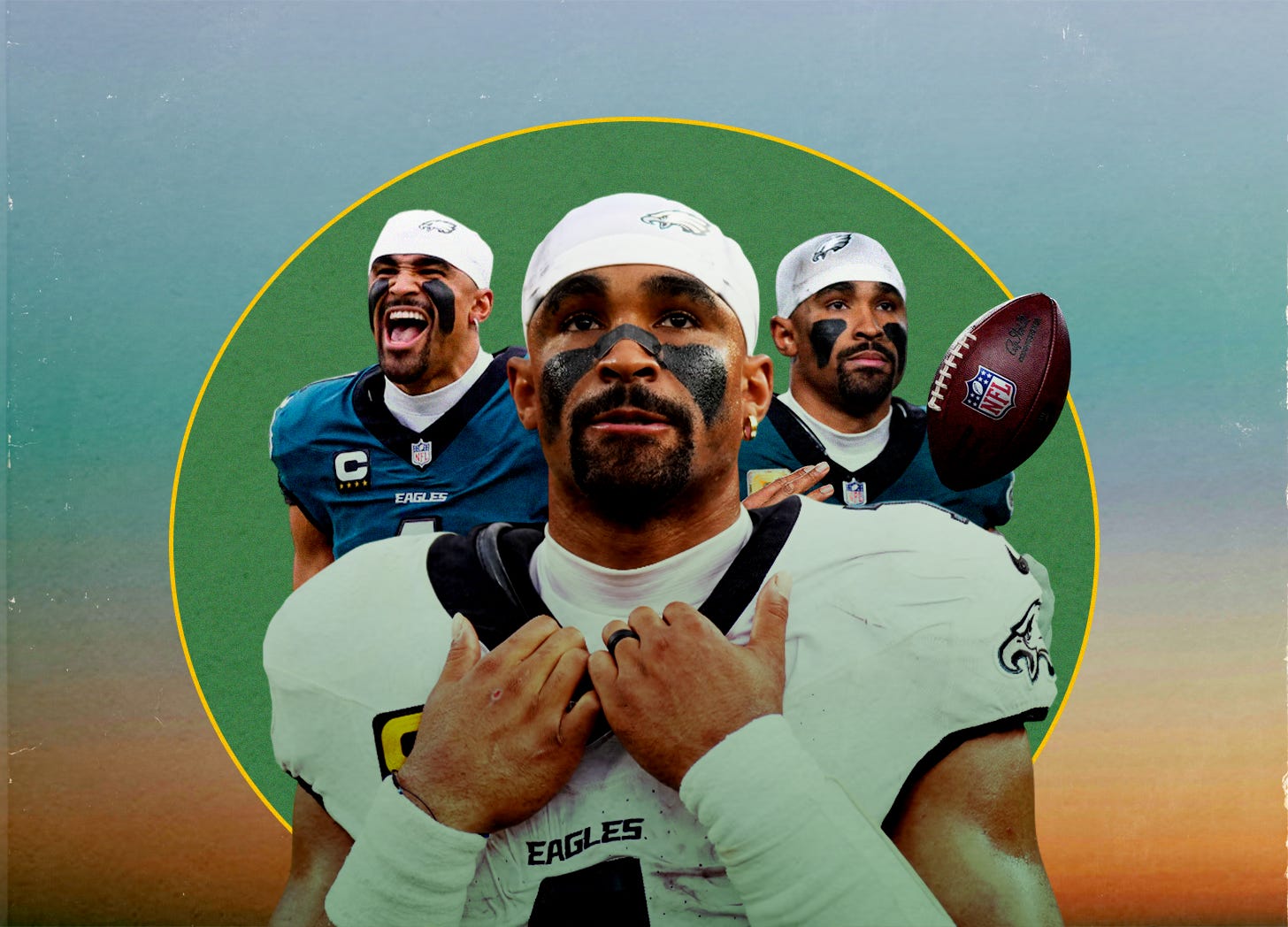
There’s a story about a man who defied logic. Who carried unearned confidence on his back. Unearned in the eyes of the public, but not for those who saw him sweat, train, and struggle. He would fall and get up again with determination that bordered on insanity. Until he took all of that sweat and all of that training and all of those struggles into an arena he had no right being in against an opponent he had no chance against. And to everyone’s surprise, he won. I am, of course, referring to the plot of Rocky II (and Rocky III and Rocky IV…).
Philadelphia mythology is built on underdogs. The Creeds and Vince Papalis, who dare to grab their dreams out of thin air. It’s an American story. We love someone who is self-made. It’s reflected in the adoration we have for our professional athletes. Which begs the question, why are people so weird about Jalen Hurts?
The winningest quarterback in Philadelphia history has a story fit for a Disney movie. You know the one. The first freshman quarterback to start for Nick Saban at Alabama who was eventually benched, only to come back and lead his team to a historic comeback in the SEC championship game. Transferred to Oklahoma and became a Heisman Trophy finalist. Drafted in the second round by a team that already had a star quarterback, he grabbed the reins and eventually led his team to two Super Bowls in three years and one Super Bowl victory. Outdueling potentially the greatest quarterback of all time on football’s biggest stage, twice. You know, Disney stuff.
Despite winning 64.7% of his games as a starter, winning a Super Bowl, and never missing the playoffs as a full-season starter, a portion of NFL fans perpetually question Jalen Hurts’ ability to do the things that he’s already done. It’s a constant trending topic on Twitter or a segment on “name your ESPN debate show.”
For all intents and purposes, Hurts should be a pretty uncontroversial figure. Off the field he’s quiet, focused, and very private. He’s known for having high character and an intense dedication to his craft. He’s an avid philanthropist who has changed lives in Philadelphia through his foundation, including donating $200,000 to provide 300 air conditioning units to the School District of Philadelphia. He recently wrote a children’s book. Hurts has cemented himself as a cultural figure who connects with a wider coalition of fans non-NFL fans and those who are new to the game.
Yet in a league that employs many struggling quarterbacks and difficult personalities, Hurts is the lightning rod. The fire that draws trolls out of their caves. Fodder for beefs in the comment section and a money maker for engagement bots. Out of all of the flawed players in the NFL, why is it that a Super Bowl MVP with one of the highest winning percentages in the league is the one makes people so mad?
Jalen Hurts, The Quarterback
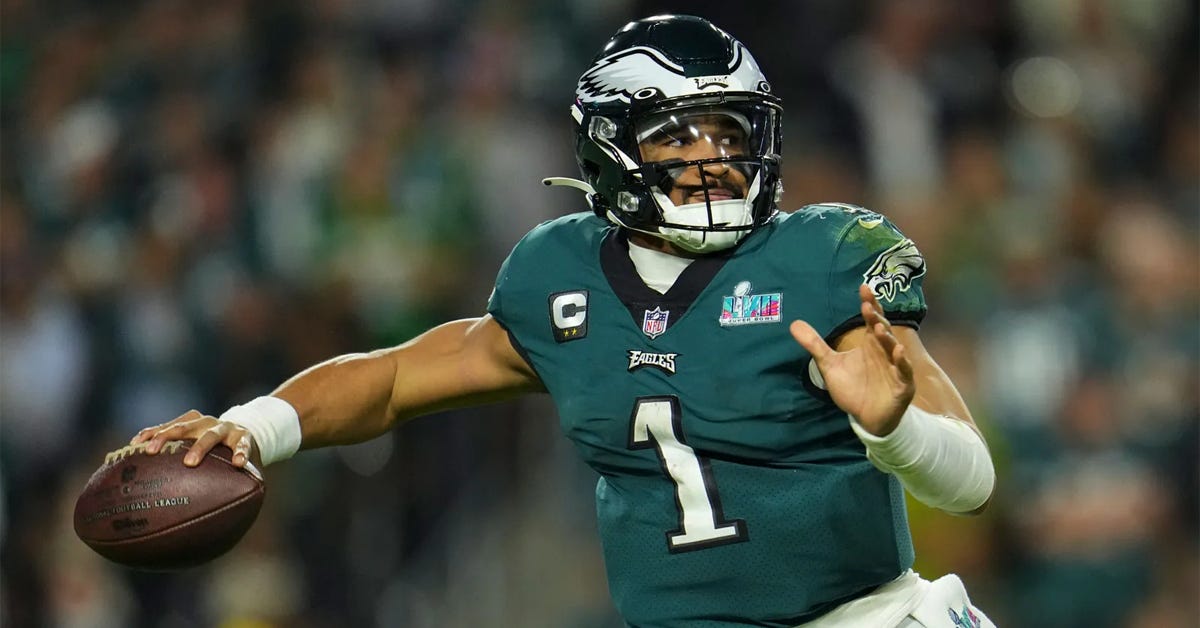
Following a difficult year and the worst offensive output of the Nick Sirianni era, Hurts and the Eagles are at an inflection point. They’ve brought in a new offensive coordinator in 33-year-old Sean Mannion. Rumors continue to swirl about their intentions to trade away star wide receiver A.J. Brown. And owner Jeffrey Lurie has expressed his urgency for a third Lombardi Trophy. The Eagles are looking to win now while building a sustainable future with an aging offensive championship core. At the eye of the hurricane sits Jalen Hurts.
A recent ESPN piece by NFL reporters Tim McManus and Jeremy Fowler sparked outrage this week, detailing the friction within the Eagles organization, primarily centered on Jalen Hurts and how his preferences, personality, and fringed relationships have contributed to the Eagles offense becoming “calcified.”
Outrage on your Twitter feed aside, if you read the article, McManus and Fowler are very fair about Hurts strengths and shortcomings. They provide balanced reporting from multiple sources that often conflict (many of whom are anonymous which isn’t ideal). On the field, the article focuses on an infamous moment in the 2026 playoff game against the San Francisco 49ers (a moment I have chosen to black out from my memory, even though I was at the game).
On 4th down with the game on the line, the Eagles made a baffling call to run a basic four verts play as their last gasp. The play (predictably) failed, and the Eagles were bounced from the playoffs by a weak Niners team. McManus and Fowler state that the call was a preference by Jalen Hurts, reporting:
As one team source recalled, Hurts was the one who recommended four verts. A separate source with knowledge of the situation says that though the Eagles’ quarterback did suggest it, he was simply responding to a question about his preferences.
Hurts is a flawed quarterback, much like every other quarterback in the NFL. Justin Herbert and Lamar Jackson struggle to win big postseason games. Josh Allen’s controlled deconstruction of defenses can unravel into unwavering chaos. Joe Burrow has an extensive injury history. Hurts is no different.
He can hold onto the ball for too long, he can audible to the wrong play, he can be too conservative, and he often turns down tight window throws. But he also makes dynamic plays out of structure, throws a beautiful deep ball, elevates the team as a runner, plays his best ball in the biggest moments, and most importantly, wins and wins often. Within the City of Brotherly Love, we know of Hurts imperfections, which makes performances like last year’s Super Bowl victory even sweeter. The story of Jalen Hurts is one of a quarterback capable of overcoming those imperfections to accomplish great things.
And therein lies the rub. Or at least the start of it. Hurts’ value is in the eye of the Kelly Green beholder. There’s discomfort in the juxtaposition between his victories and his stats. It leads to conflicting takes about whether or not he’s elite. Where he ranks on quarterback power rankings, or how he compares to other quarterbacks who are easier to define by traditional standards. Hurts detractors vehemently swear that he’s an overrated player who’s carried by his team, unlike many of his peers. Even though the main thing Hurts does so well is the very reason we play the game. He wins.
Whether it’s the impossibly high standards we put on Black quarterbacks (a very real conversation for another time), lack of understanding of his value, or the extremely talented Eagles roster who’s dominance diminishes individual contributions, Hurts never seems to get a fair shake. The strength of your roster is a fair point for any NFL player, but who are we to diminish an individual’s contributions based on hypotheticals. The team you’re on is the team you’re on.
Aside from otherworldly physical traits, Hurts superpowers are scoffed at as intangibles that are hard to measure. Primarily, his ability to win and his ability to improve year over year. One instance that speaks to this in McManus and Fowler’s article is Hurts’ improvement against zone coverage last season.
He faced zone coverages -- long considered a Hurts weakness by some scouts and defensive coaches in the league -- on 56.2% of the Eagles’ offensive plays, the second-highest rate of his career. His completion percentage against zone (69%) was significantly better than against man (59%).
Anyone who watched the Eagles recently knows that the offensive skill players were attempting to operate within a flawed system. One that we, for some reason, expect Hurts to overcome to prove to us that he’s worthy. Hurts is simply like any other quarterback, elevated by good coaching and brought down by bad. The untimely four verts call is an example of that. Hurts existed within a system he no longer trusted, so he subverted it. The same way employees do when they work for a CEO with little to no vision. As McManus and Fowler wrote:
In (Kellen) Moore, he had a coach who, according to a team source, was matter-of-fact about how the offense would function and in correcting Hurts’ mistakes when necessary. It was a similar dynamic with Steichen. When lines were more blurred, like in 2023 when Hurts, Sirianni, and then OC Brian Johnson weren’t aligned in their visions, Hurts had more of a tendency to search for answers outside of the game plan, a team source said.
While imperfect and overly critiqued, Hurts commands high praise from beloved Hall-of-Fame caliber quarterbacks. Peyton Manning has said of Hurts that “his appreciation of the cerebral part of the game is what is impressive to me” and “I think the sky is the limit for this guy.” Tom Brady has offered praise in the past. Michael Jordan has shown his admiration. But despite the endorsements and the results, Hurts’ standing in the NFL continues to be questioned.
Jalen Hurts, the Teammate
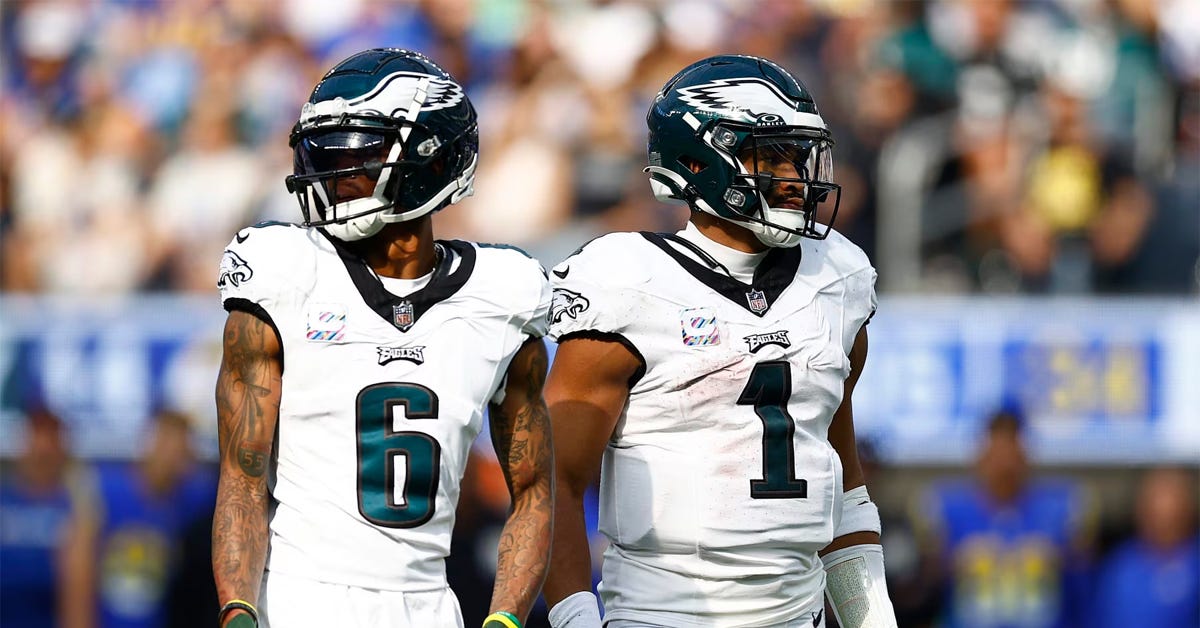
“(He’s) got a lot of self-esteem and he feels comfortable being by himself, feels comfortable with his own world. I do know on the road, most of the time, he spends it in his room.” This is a quote from Phil Jackson about Kobe Bryant in an interview with 60 Minutes in 2001. Bryant, like Michael Jordan before him, was defined by his maniacal work ethic, unrelenting intensity, and difficult personality. But also Kobe, like Michael before him, kept winning.
As I wrote last year, Jalen Hurts is one of many athletes that abides by what I call The Michael Jordan Intensity Operating System. A “win-at-all-costs” mentality that uplifts work ethic and dedication to the game, but also one that can fray relationships with teammates and coaches. McManus and Fowler described Hurts well, saying:
Hurts is an introvert by nature, sources close to him said, which can make him hard to read. Some might view him as a stoic leader with the calm approach needed to navigate the exaggerated ups and downs that come with playing in a rabid sports city such as Philadelphia. Others might view him as detached and above it all.
They continued, saying of Hurts,
His steely resolve can be both a benefit and a hindrance as the face of the franchise. Force fields are good for keeping unnecessary distractions out but bad for connectivity and allowing essential items in.
Coach Nick Sirianni has compared Hurts’ leadership-style to Michael Jordan, and his agent, Nicole Lynn, “likened his obsessive work ethic to that of former Los Angeles Lakers great Kobe Bryant.” As McManus and Fowler wrote, “that unrelenting, demanding mentality toward not just himself but his teammates can be met with mixed reactions.”
The dynamics of an NFL locker room are complicated. The same way they are in a workplace, a community, or a home. Mounting pressure can shapeshift relationships. Feelings get hurt. Friendships are tested.
An example of this is Hurts’ well-documented relationship with A.J. Brown (which I wrote about last year). McManus and Fowler reiterated the struggles, saying:
Multiple team sources say they never saw Brown and Hurts engage in an argument during the season and were professional throughout the season. But both also tend to internalize issues, which leads to a lack of communication, sources said. “Clearing the air probably doesn’t happen as often as it should,” a source said.
Hurts is stoic and calm but also fiery and demanding in his own way, wanting to do what it takes to win. That relentless demand brings visions of Kobe and Jordan, and I have no doubt it can rub people the wrong way. But Hurts is not Kobe (just ask Smush Parker) or Jordan (just watch The Last Dance).
Phil Jackson referred to Kobe as “uncoachable” and “would go against the grain of the team.” Phil wasn’t the best, but that speaks to how Kobe was perceived at the time. Steve Kerr (who got in a fist fight with Michael Jordan) once said that “Michael would just bludgeon everyone around him.” Jordan himself once said, “If you don’t get on the same level as me, then it’s going to be hell for you.” Both were difficult personalities, but we all decided that the results justified the means. So many athletes formed their perspectives from watching Michael and Kobe. A crazed competitiveness that defined generations.
That’s not necessarily Hurts, although parts of it are. While demanding and naturally reclusive, Hurts has made an effort to change. We’ve seen him hold himself accountable and continue to learn and evolve. Hurts worked with Nick Sirianni to fix their rift, which led to a Super Bowl-winning season. He’s made an effort to come out of his shell and connect with his teammates. McManus and Fowler reference Brandon Graham speaking of Hurts working to change after receiving criticism that he’s not vocal enough or connecting with teammates, saying:
“It’s big of him to be stepping out because he’s the top dog and he knows that, being that quarterback and everybody wanting to be in your presence. I’m happy he’s coming out of his shell.”
It could be that Hurts’ detractors react negatively to how his personality feels so close to Kobe or Jordan without the same level of results. We live in a culture of comparison and level-setting. No one can get too high. Hurts speaks in inspirational sayings and gives press conferences that make Nick Saban look like the most charming man alive. But Hurts is who he is and has never shied away from that.
McManus and Fowler attributed a lot of what’s happened with the Eagles offense to Jalen’s preferences, writing:
He has pushed back on changes that would diversify the scheme, sources said, including when it comes to him going under center more. He has shown a reluctance to let it rip at times, particularly against zone coverage. He diverts from the game plan and changes playcalls to what some feel is an excessive degree. His strong preferences, coupled with the coaches’ efforts to play to his strengths, which include his deep-ball accuracy and throws to the perimeter, limit the breadth to which the offense can expand -- or at least that’s the way it has gone in the past.
Mike Tomlin once said, “I love to hear coaches resist the responsibility of coaching…they talk negatively about a dude that can’t learn…if everybody could learn, we’d need less coaches. If the group didn’t need management, then we wouldn’t make as much.” As a coach’s son who played under one of the most demanding college football coaches of all-time and has shown an ability to listen to leaders with a clear vision, I don’t think we can say Jalen Hurts isn’t coachable. Every NFL player has their preferences. It’s the job of NFL coaches to decide when to lean into those preferences and when to do what is best for your team and your vision. It’s Nick Sirianni’s responsibility to say that we shouldn’t run four verts.
If the Eagles want to soar back to championship heights, they need to be unafraid to push Hurts out of his comfort zone. To coach him hard. Nick Sirianni and his staff need firm belief in a system, rigid expectations, and a lack of fear to push their star quarterback to do the things he doesn’t like doing. Discomfort is how you grow. That’s what coaching is for.
Hurts, who is on his 6th offensive coordinator in 7 seasons, has had to learn and unlearn over and over again. And despite the change, he has reached the pinnacle of his sport.
His story is an underdog story. A player who may not be for everyone, but definitely isn’t worth the strife.
I think (a) he seems like a great guy, so only criticism is about his play and (b) I think when you have 2 great receivers and a great RB and we’re playing a try-not-to-lose style on offense it just becomes frustrating to watch, regardless of the W/L record. And despite the OC issues and playcalling, it’s hard not to put some of that blame on Hurts at this point in his career—righty or wrongly.
I don't even follow the Eagles to this degree but I have been following this Jalen Hurts media drag. It's really unfair to a guy who has dealt with such constant change at coaching. He's outlasted most of his offensive play callers, so forgive him for picking what he knows works for him. It's hard to establish trust with that much turnover.
As an introvert myself, staying in the hotel by yourself makes sense. The amount a QB has to put out in extroversion energy on game day is alot. He probably needs most of that time to charge his social battery to do the job.
It's easy to say if you're a QB to be outgoing and relatable, but talent doesn't = personality. Jalen may have some areas to grow there, as far as expanding his social capacity, but he's done a great job on the field.