



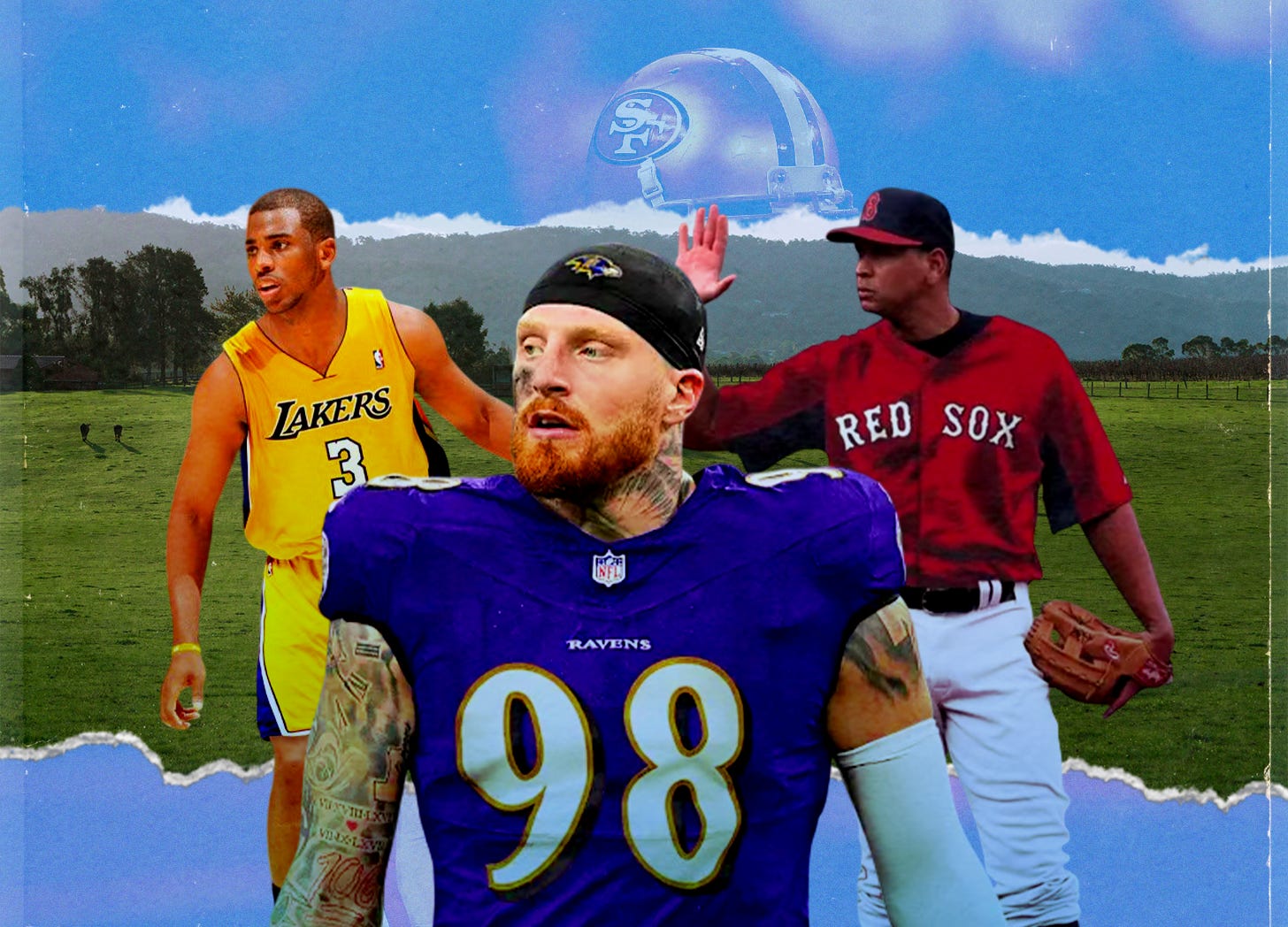
After committing truancy, terrorizing a small town, and driving his friend to a mental breakdown, Ferris Bueller once said, “Life moves pretty fast; if you don’t stop and look around every once in a while, you might miss it.” That also pretty much describes Maxx Crosby’s career with the Baltimore Ravens. (Editor’s note: I have an idea for a sequel called Ferris Bueller’s PTO where a grown-up Ferris plays hooky from work and loses his job.)
It’s been a little over two weeks since the Ravens backed out of the blockbuster deal that would bring Crosby to Charm City for the cost of two first-round picks. The Ravens went into full panic mode. They had 8 modelos, got married to a stranger in a Vegas chapel, and woke up the next morning regretting their decision. They used a failed physical by Crosby to pull out of the deal and sign Trey Hendrickson at a lower cost instead. It’s a move that has already had ripple effects across the league. As Al Pacino once shouted in the raspiest voice you’ve ever heard in your life, “Life is a game of inches, so is football.”
Ravens GM Eric DeCosta leaves us with one of the biggest “what-ifs” in football history. Crosby is a game wrecker who could’ve wrecked games on Baltimore’s behalf. The man spells his first name with two x’s; he’s built for this. Crosby could’ve been the missing piece the franchise needed to compete for their first Super Bowl since 2013, and a chance for Lamar Jackson to finally breathe in that championship air. Instead, Crosby is banished back to the shadow realm (also known as Las Vegas) to hang out with Tom Brady’s weird trainer while trying to drag the Raiders out of their 20-plus-year slump.
The Crosby situation evokes memories of other players who were on track to play for a certain team before things fizzled out at the last minute. We’ll call them the Never-There All-Stars. Players whose illustrious careers include legacies for teams they’ve never even played for. Those small decisions changed football history. Life is a game of inches, so is football.
So today I’m linking up with one of my favorite Substack writers Tommy McNamara to dive into our favorite Never-There All-Stars and explore the stories of some “almost happeneds” and “could have beens” all while Tommy tackles some Giants PTSD and I get mad at Chip Kelly all over again.
Brett Favre to Tampa Bay Buccaneers
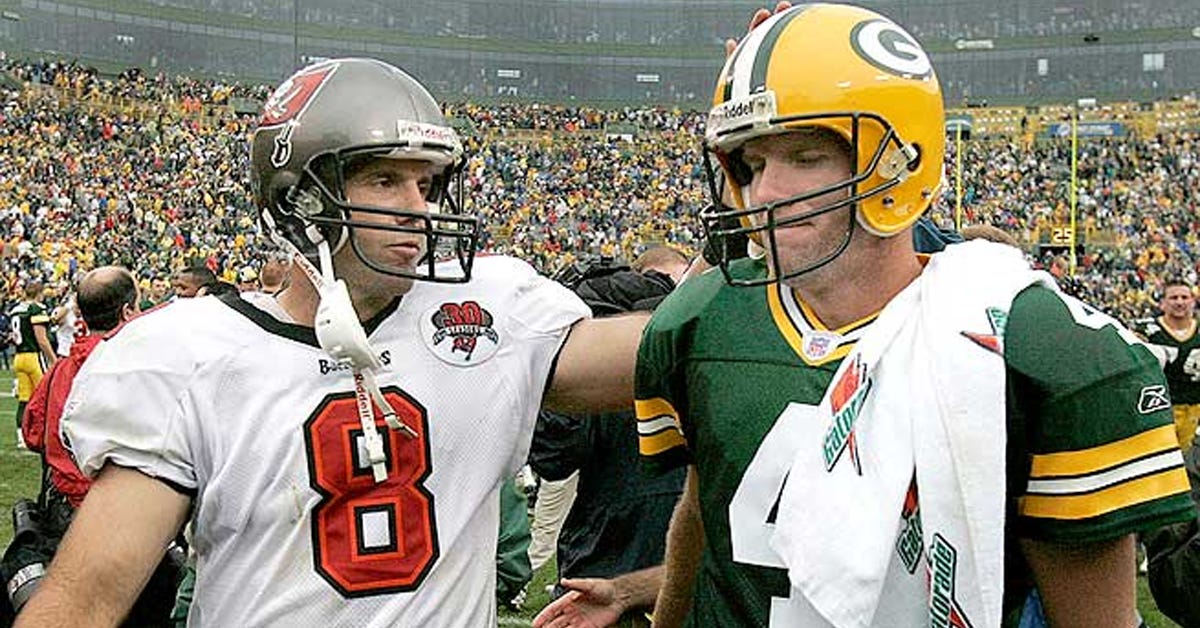
TOMMY: As I was researching this trade, I was reminded that Favre’s last pass as a Packer was an overtime pick to Corey Webster in the 2007 NFC Championship Game. That sent me down a rabbit hole of nostalgia and bitter anger at what the piece-of-shit Giants have become, but this isn’t about that.
Maybe that bitterness bled into my view of Brett Favre. Or maybe the research just reminded me that I always kind of thought he was a dick. I loved watching him play and respect the hell out of his game, but whether he is or was a dick has no impact on what happened between him, the Bucs, his agent, and eventually, the Jets.
With 2005 first-round pick Aaron Rodgers, another dick with caveats, waiting to take over, and Favre throwing two overtime interceptions in the playoffs over a four-year stretch, the Packers were ready to move on from their three-time MVP and Super Bowl champion.
The 2007 Jon Gruden-coached Bucs won the NFC South at 9–7 but were bounced in the Wild Card round by the New York Giants (nostalgia, bitterness). They were looking for an upgrade over the aging but efficient Jeff Garcia, who had 13 starts, a 64% completion rate, 13 touchdowns, and 4 interceptions at 37 years old. A reunion between Gruden and Favre, who had previously worked together in Green Bay, felt like it was lining up.
With little interest around the league and Tampa Bay as the only real bidder, Favre believed the deal was a foregone conclusion. The Bucs staff was celebrating, and Favre had already started studying the playbook.
What unfolded, according to former Bucs GM Mark Dominik with additional reporting from JoeBucsFan, was that Tampa did not push hard enough. They were essentially bidding against themselves and did not want to overpay. The Jets ended up landing Favre for a conditional fourth-round pick. It could escalate to a second if he played 70 percent of snaps and the team made the playoffs, or even a first if they won the Super Bowl.
The Bucs had a deal in place, and Favre was on board. But when news broke publicly that he had been traded to the Jets, not Tampa, without his knowledge, everything shifted.
Favre told the Orlando Sentinel, “[Mike Tannenbaum] knew that by making that trade there was a chance I could turn it down, but when the trade was made and it was public news without my knowledge, how could I change my mind?”
“There had been enough dirt kicked around up to that point. That’s basically what happened. And it was a tough, tough decision. When that was done for me, without my consent, I was like, ‘I’m not going to make things any worse.’ And I think that’s exactly what the Packers were banking on.”
Jeff Garcia returned as the starter for the Bucs, who again went 9–7 in 2008 but finished third in the division after losing their final four games, which cost Gruden his job.
Favre started all 16 games for the 2008 Jets, who also went 9–7 and missed the playoffs. He threw 22 touchdowns and 22 interceptions. A year later, he nearly took the Vikings to the Super Bowl, falling in overtime to the Saints.
Here is how Dominik looks back on it:
“I look back on that and say if we had just upped our ante a little bit more, I wonder how many lives would be different than they are today versus Brett going to the Jets and then Minnesota. Because we went 9–7 in 2008 without Brett Favre, and I gotta think we would have been 11–5 easily, if not better, with Brett Favre, and that would have been awesome to see.”
Frank Gore and the Philadelphia Eagles
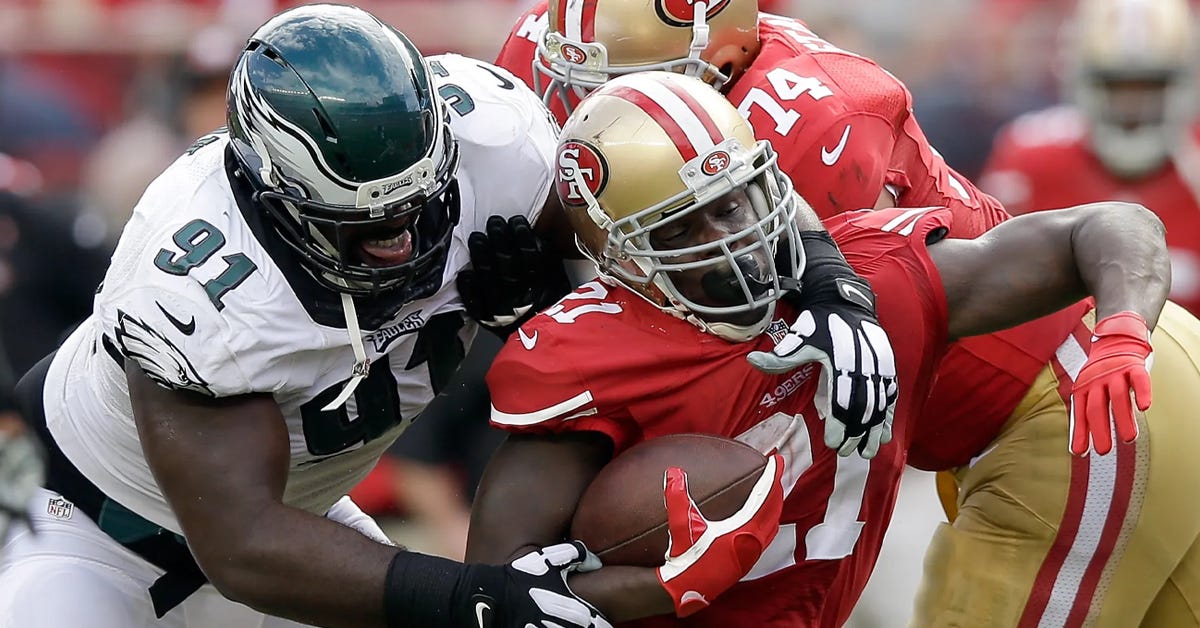
JEREMY: Coming off his second 10-6 season with the Philadelphia Eagles, Chip Kelly went full Napoleon mode to seize ultimate control of the team. He traded away star running back LeSean McCoy, planted a story fabricating star wide receiver DeSean Jackson’s gang ties, traded future Super Bowl MVP Nick Foles for Sam Bradford (a man whose sleeves were longer than his career in Philly), and banished Howie Roseman into a closet in the Novacare Complex. Don’t let anyone tell you that a team can’t change its fortunes in an offseason.
After agreeing to a monstrous deal with promising (and future catastrophic) cornerback Byron Maxwell to start the offseason, Kelly had his eyes set on bringing legendary 49ers running back Frank Gore to South Philly. Gore was one of the most productive running backs in the league. A consistent top 5 fantasy pick that your most desperate friend kept trying to trade you Ben Roethlisberger and Laverneus Coles for. He was steady and reliable, a walking 1000-yard season and the perfect fit for the offense Chip Kelly wanted to run.
During the legal tampering period, Gore agreed to a deal with Philly. The streets rejoiced. Losing LeSean McCoy sucked, but at least an NFL legend was entering the building. But less than 24 hours later, fortunes had changed.
Gore backed out of his deal with the Eagles to play with Andrew Luck and the Chuck Pagano-led Indianapolis Colts. Gore explained his decision years later, saying:
“Nick Foles called me, I committed to him and said I was going to come. He called me, said congrats, can’t wait to get on the field. And then the next day he gets traded. Then I see Jeremy Maclin, he goes to Kansas City…so I saw the Colts, they were off the AFC championship, I thought if I go to the Colts and I called Andre Johnson, I think we can get them over the top. That’s why I went to Indy.”
The 2015 Colts went 8-8 before firing offensive coordinator Pep Hamilton (whose name sounds like a character from the Pixar movie Cars) mid-season and replacing him with Rob Chudzinski (whose name sounds like your frat brothers’ brother who would come to visit and pass out at 8 pm from a serious case of intoxication). They lost the division for the first time in 4 years to the Bill O’Brien and Brian Hoyer-led Houston Texans, but Gore played well. He ran for 967 yards and 6 touchdowns in 2015 and had his last 1,000-yard season with the Colts in 2016.
As for the 2015 Eagles, they crashed out like your friend who’s losing in Settlers of Catan and flips the board out of frustration. Chip Kelly thought he was conducting an orchestra, but instead was conducting a 10-car pile-up. The Birds pivoted from Gore to sign former Cowboys running back DeMarco Murray, who went from rushing for 1,845 yards and 13 touchdowns with Dallas to rushing for 702 yards and 6 touchdowns in Philly. The Eagles went 7-9, missed the playoffs, and Chip Kelly was fired, leading to Howie Roseman’s re-emergence and subsequent revenge tour that brought Philadelphia its first Super Bowl just two years later. Karma is a Birds fan.
A-Rod to Red Sox
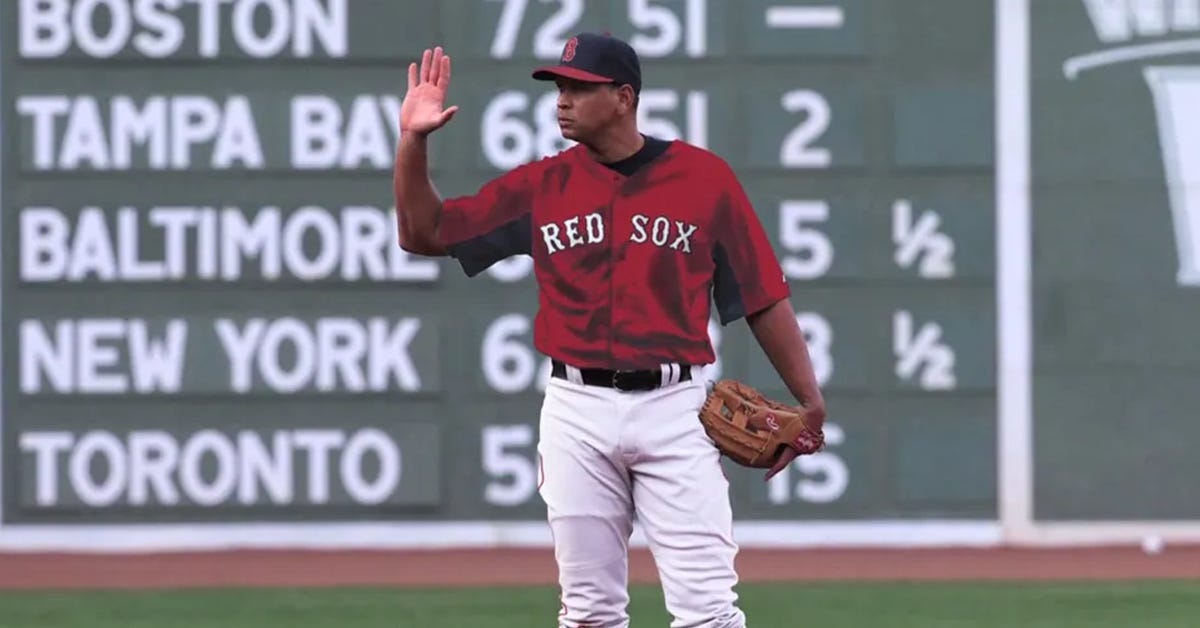
TOMMY: I mentioned I was bitter writing about two teams that the Giants defeated on their way to their glorious Super Bowl victory against the undefeated Patriots. This isn’t about that, but I wish it was.
Researching this trade took a serious emotional toll on me. The only thing keeping me from DMing Jeremy right now to say I don’t want to do this trade is how the 2009 season ended in Yankee Stadium. This isn’t really about that either.
On December 11, 2000, the Texas Rangers signed Alex Rodriguez, the 25-year-old shortstop coming off three consecutive 40-plus home run seasons, to a fucking gobsmacking, at the time, 10-year, $252 million contract. Over the next three years, A-Rod put up two 50-plus home run seasons, won an MVP, and earned two Gold Gloves. What he didn’t do was play in a playoff game. The Rangers finished last in their division all three years.
With a massive financial burden and no team success to show for it, the Rangers started looking for suitors.
Enter the piece of shit, goddamned, motherfucking Red Sox, from here on out referred to as the Red Sox.
And so my pain begins with one of the most joyful moments of my non-father, non-husband life (just in case she reads this), and the last game of the Red Sox 2003 season. In the bottom of the 11th inning, in a 5-5 game, Aaron Boone sent Tim Wakefield’s first pitch into deep left field, sending the Yankees to their sixth World Series in eight years and sending their rivals home disappointed again.
Their plan to overcome the “Evil Empire” (give me a fuckin break) was to acquire the reigning MVP, Gold Glove shortstop, and finally break the curse from 1918.
Reading ESPN’s 30 for 30 Shorts: How the Sox Lost A-Rod reminded me of the deal that was on the table:
Red Sox receive: Alex Rodriguez
White Sox receive: Nomahhhh (Nomar Garciaparra)
Rangers receive: Manny Ramirez and Jon Lester
The issue was the $179 million remaining on A-Rod’s deal. Theo Epstein called it a “non-starter.”
A-Rod, who at the time and many times after I thought was a total dick, agreed to reduce his salary to join the Red Sox at shortstop. He even signed the restructured deal.
The Players Association put the kibosh on it, worried it would set a precedent that could cost other players money. Trade over. Fuck the Red Sox. Yes.
Enter the New York Yankees. Fresh off Boone’s home run, he promptly blew out his knee playing basketball, and the Yankees suddenly needed a third baseman.
A-Rod had already agreed to less money, not a very dickish thing to do. Now the Yankees asked him to change both his number and his position, moving off shortstop, where he was unquestionably the best regular-season shortstop in the game, for a chance at a title. He agreed. Not dickish at all.
The Yankees essentially traded Alfonso Soriano, a great regular-season player and a dog shit postseason second baseman, to the Rangers for A-Rod, with Texas sending cash.
Now the stage was set for the Yankees to dominate the Red Sox for years to come. More championships, more shit-talking. It all lined up perfectly. Varitek versus A-Rod during the regular season, rivalry boiling over, and then the Red Sox and Yankees meet again in the 2004 ALCS.
We all know the story, and I am still dealing with the emotions, but I’ll recap it quickly.
The Yankees jumped out to a commanding 3-0 series lead. Game 4, up a run in the ninth. Yada yada yada, Mueller grounded off Mo, the Red Sox win that game in 11 on a David Ortiz home run, take the next three, including another extra innings win (maroooooooone), Big Papi, and go on to sweep the Cardinals and break the curse.
They would win two more World Series before A-Rod retired in 2016.
Ultimately, A-Rod did get his long-awaited World Series ring in 2009 with the New York Yankees, but this isn’t about that.
Eli Manning and the Chargers
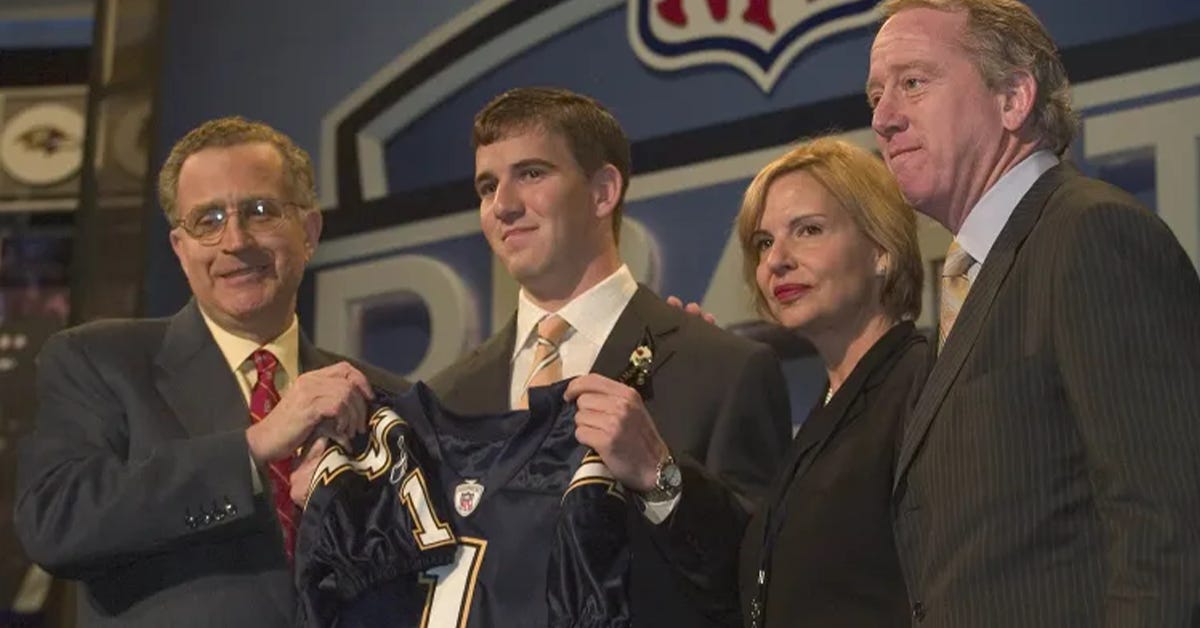
JEREMY: Imagine you’re fresh out of college. You get an opportunity at a consulting firm, but it’s not the one you want. So you demand they send you to that other firm or else you’re not showing up on Monday. That’s pretty much what Eli Manning did in 2004. The balls, the chutzpah, the cojones.
The 2004 draft class was loaded with talent, including quarterbacks Eli Manning, Phillip Rivers, and Ben Roethlisberger (side note: is the 2004 draft the greatest of all-time? It also included Sean Taylor, Kellen Winslow, Jonathan Vilma, Vince Wilfork, Steven Jackson, Jason Babin, Karlos Dansby, Julius Jones, and Bob Sanders.) At the top of the draft was good ol’ Eli, coming off a legendary season at Ole Miss.
The San Diego Chargers had long struggled to find their quarterback of the future. San Diego was a place where young quarterbacks went to fail, from the Ryan Leaf disaster to an underwhelming first two seasons from a young quarterback out of Purdue named Drew Brees. With that in mind, general manager A.J. Smith and head coach Marty Schottenheimer had their sights set on Eli.
But Manning was football royalty. His nobility gave him some sway and he intended to use it. Knowing that San Diego was going to draft him, he told them thanks but no thanks as his camp told the Chargers that he wouldn’t play for them if drafted there. Manning said this years later to CBS Sports:
“Going through the draft process, I was just worried about the Chargers organization at the time. I felt it was the right decision and I had a little pull. I quietly tried to say ‘Hey, please don’t draft me, it can be our secret,’ and they didn’t keep the secret part very well.”
Word of the possibility of Manning refusing to play for San Diego reached Giants general manager Ernie Accorsi. The Giants were slated to pick 4th that year and were looking to draft Ben Roethlisberger out of Miami Ohio. In NFL Meetings that spring, Accorsi let San Diego know that New York would be interested in making a deal if Manning’s threat came to fruition. But San Diego called the bluff.
They chose Manning number one on draft night, and things went as predicted. Like when your girlfriend says she doesn’t want to go see the new John Wick, so you decide to take her there on a surprise date, hoping it will change her mind.
Eli refused to go to San Diego, forcing the Chargers to make a deal with New York. They landed on trading Manning to New York in exchange for #4 draft pick Phillip Rivers, a 2004 3rd round pick (that became Nate Kaeding, one of the best Chargers kickers of all-time), a 2005 first-round pick (that became All-Pro linebacker Shawne Merriman), and a 2005 fifth-round pick.
Manning went on to lead New York to two Super Bowls. In San Diego, Drew Brees ended up having his two best years with the Chargers after Rivers was drafted but left for New Orleans in 2006. Rivers became the great quarterback the Chargers had been waiting for, developing into one of the best players in the league and starting for the team until 2020.
The Oppenheimer moment for the Eli Manning trade was John Elway threatening to play for the Yankees when he was drafted by the Baltimore Colts in 1983, before finally being traded to Denver. The general manager for the Colts at the time was none other than Ernie Accorsi.
Chris Paul to the Lakers
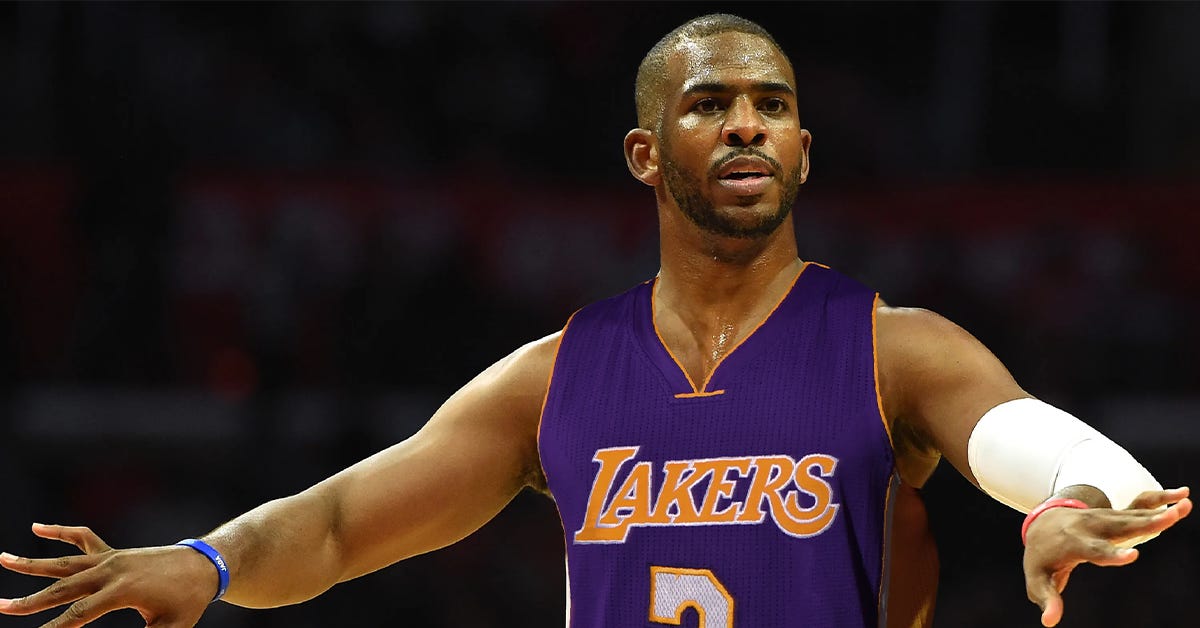
JEREMY: The Phil Jackson Lakers dynasty was finally coming to a close. After rediscovering themselves in the late aughts to win two championships in three years, Kobe’s purple and gold were ousted in the conference semis by the eventual champion Dallas Mavericks and Dirk Nowitzki. The worst kid in your math class who wore a Pau Gasol jersey to school every day was finally quiet.
The following season, the league entered a 5-month lockout that ended with a new collective bargaining agreement centered on competitive balance between large and small market teams. With the lockout coming to a close, the Lakers thought it was the perfect opportunity to reassert their dominance by trading for the league’s best point guard. A real “you come at the king, you best not miss” moment.
Chris Paul was coming off an all-star season with the New Orleans Hornets, but made it clear that he intended to become a free agent after the season instead of signing an extension with the team. The Hornets were a mess. Their owner ran out of money, and they were technically owned and operated by the NBA itself. Paul wanted out.
Lakers general manager Mitch Kupchak smelled blood in the water and reached a deal with the Hornets to acquire the Point God in a three-way trade that would give the Hornets Lamar Odom, Kevin Martin, Luis Scola, Goran Dragic, and a 2012 first-round pick, while trading All-Star big man Pau Gasol to Houston.
Kobe Bryant and CP3 would’ve been a revelation. One of the greatest scorers of a generation, paired with one of the greatest point guards of all-time, not yet at his apex. The toxicity of their personalities alone would’ve been the stuff for an HBO Original Series. Unfortunately, the NBA owners deprived us of that rich potential. In less than an hour, NBA Commissioner David Stern informed the teams that the deal could not happen.
The NBA owners were outraged at the big-market Lakers continuing their dominance with a trade like this. The owners and Stern argued that it obstructed the competitive balance that the whole lockout was meant to solve. Cleveland Cavaliers owner Dan Gilbert (who I imagine talks like a kid who’s a temper tantrum away from being placed in time-out), in an email to Stern, called the trade “a travesty” and said, “I just don’t see how this trade can be allowed to happen.” Gilbert got his payback when LeBron James left Cleveland to form a superteam with Dwyane Wade and Chris Bosh in Miami. He who fucks around finds out.
As a result, Paul was instead traded to the Los Angeles Clippers for Eric Gordon, Chris Kaman, Al-Farouq Aminu, and a 2012 first-round pick (which became Austin Rivers). The Lakers pivoted and acquired Steve Nash in a sign-and-trade from Phoenix while also trading for Dwight Howard in a four-team trade, which resulted in Andrew Bynum heading to the 76ers (a point I only mention because I’m a Sixers fan and still mad about it). The Lakers superteam crashed out under Mike Brown, and Paul helped lead one of the most successful eras of Clippers basketball.
Still, we dream of what could’ve been with Chris Paul and Kobe yelling at each other on the bench while leading the Lake Show to their first championship in the post-Phil Jackson era. We don’t know what we missed.
Solid work here gentlemen. When I saw the post, I was glad to see the CP3 trade in there. That one was wild. Elway on the cutting room floor was a good call. It was interesting to read and think about how karma on these trades doesn’t fare well, at least not immediately. Frank Gore was prob the only one who benefited straight away. Others got theirs later, or in the case of CP3, never did win a title.