


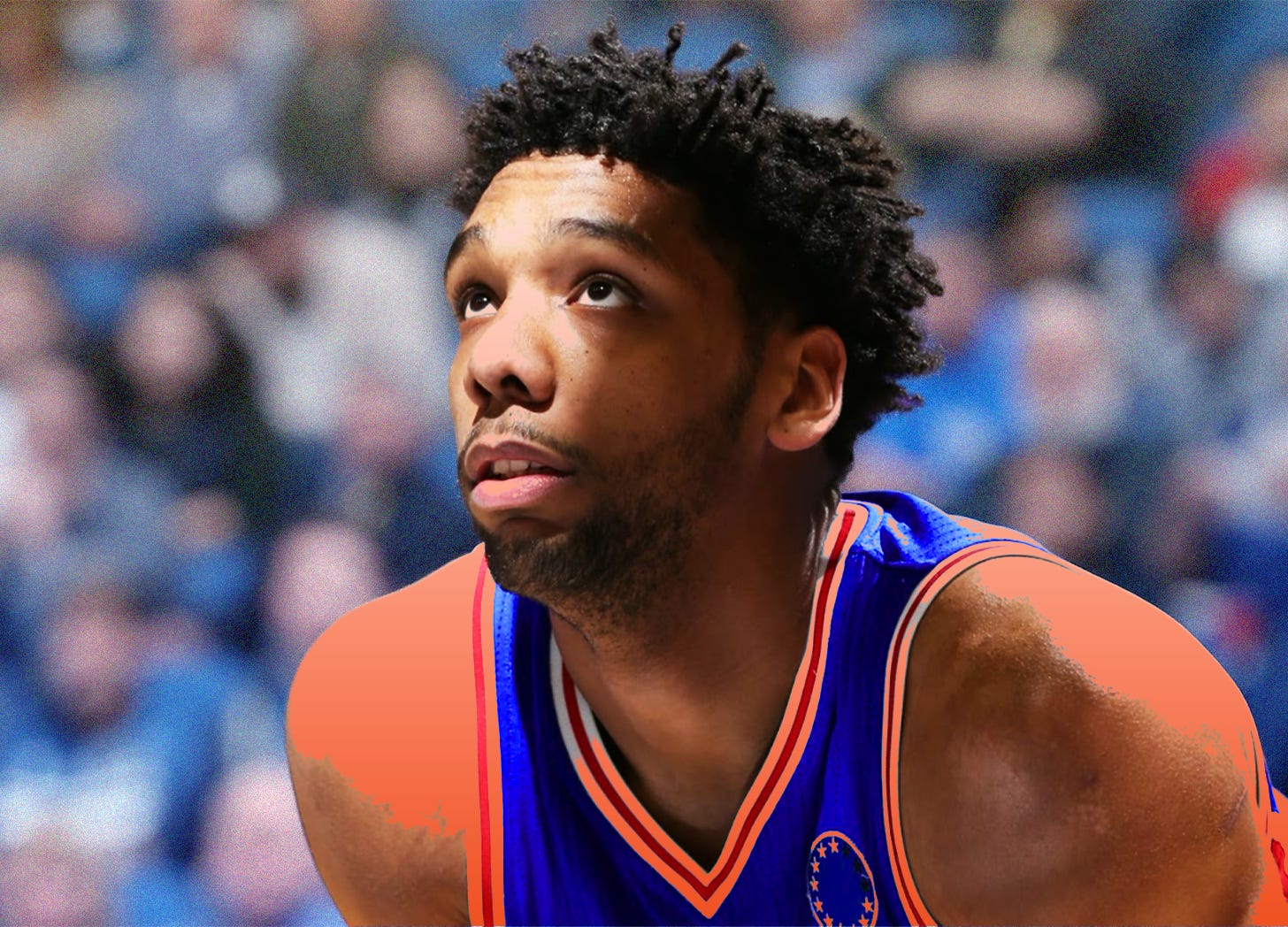
There’s a certain trauma that comes with being a fan of the Philadelphia 76ers. It’s like being in a car crash and at the time thinking “you know what, this is what’s best for me in the long run,” only to look back years later and think “actually, that whole thing was kind of messed up.”
This season, the Sixers’ vibes have fluctuated between immaculate and unfortunate. We, as fans, are addicted to their potential. Yet historically, they set up shop at the intersection of promising and unserious.
For every 30+ point game from a resurgent Joel Embiid, there’s a Paul George PED suspension. For every transcendent VJ Edgecombe moment, there’s a Jared McCain trade. For every Tyrese Maxey All-Star performance, there’s a 30-point loss to the Charlotte Hornets. We believe in the Sixers more than anything. But sometimes it feels like a curse hangs over our heads.
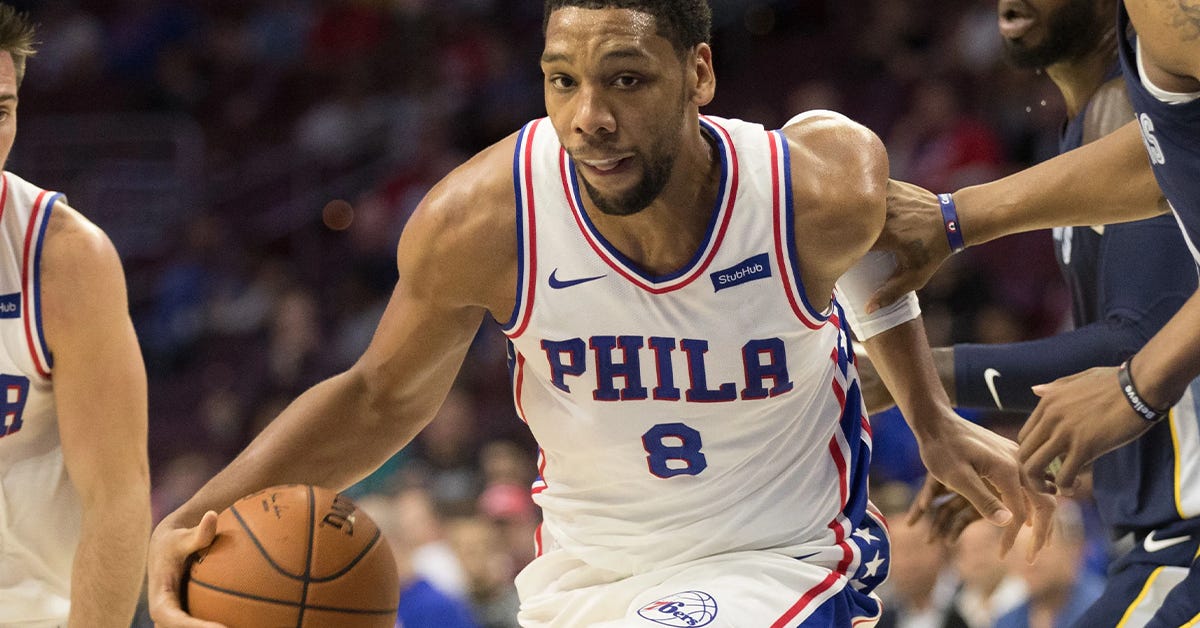
In the My Worst Sports Take series, I interview some homies about controversial sports takes they have. This week, we revisit The Process, the Sixers’ original sin, and one of the foundational players at the heart of it, Jahlil Okafor. The place where the curse started. I chat with my friend Rob Ricketts about how he feels the Sixers ruined Okafor’s once promising career and the ramifications it has on the franchise to this day.
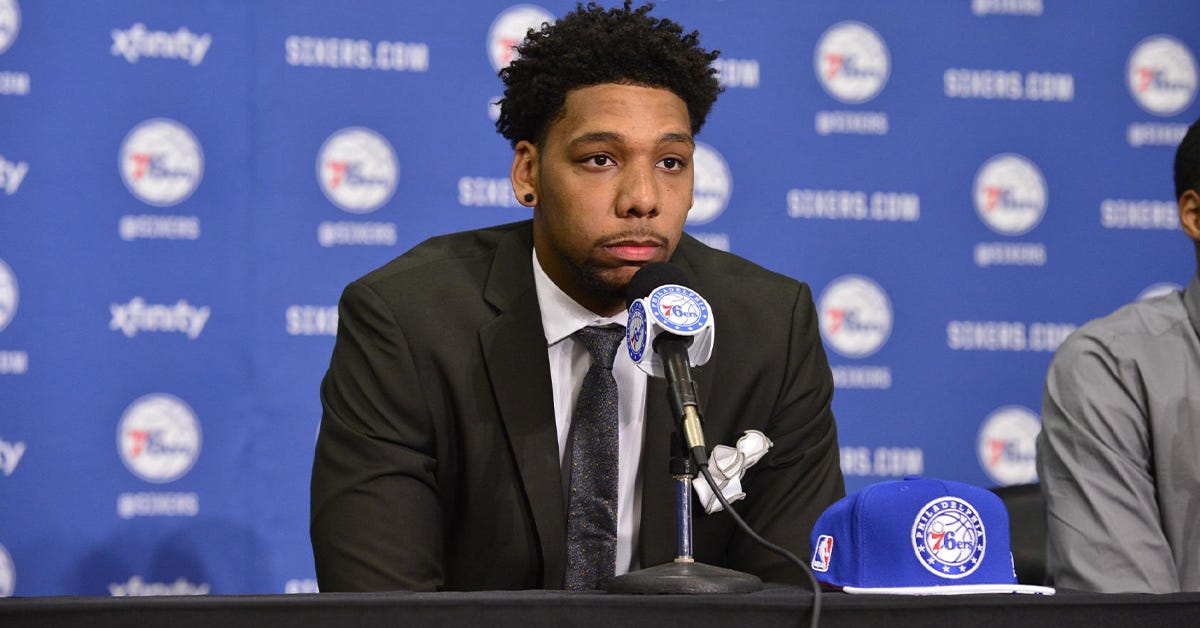
Tell us about yourself and your take.
ROB: My name is Rob Ricketts, and my worst sports take is that Jahlil Okafor wasn’t a bust, but that the Sixers ruined him and the league changed on him.
How did the Sixers fail Jahlil Okafor?
ROB: I think that by not having proper veteran leadership or a strong executive office, they didn’t allow him to grow.
I feel like you’ve been a Jahlil defender for as long as…
ROB: Free Jah, man.
You’ve been saying free Jah since 2015.
ROB: Bro, since the 15-16 season, baby.
Do you feel like most people look back on him as a bust?
ROB: Oh, absolutely. I mean, he was a top-three pick. National champion at Duke. He was expected to really be the next big thing in the league. He had a kind of crazy impact in his first year, and after that, it was like it was over. He went from averaging 17 and 7 as a rookie to being pretty much out of the league in like two years. That jawn was crazy.
So he was drafted in 2015. Can you name the two players who went ahead of him?
ROB: Was that the year with Lonzo?
Nope. I think Lonzo was the Markelle Fultz draft.
ROB: Oh, okay, that was a draft with KAT.
Yep, KAT was number one. Two was D’Angelo Russell. Three was Jah. Four was Kristaps Porzingis. Five, who I remember wanting the Sixers to draft for some reason, was Mario Hezonja.
ROB: Oh, bro, you would have been a great GM, bro.
I would have been at least Bryan Colangelo level.
ROB: A draft and a stash, huh?
Alright, so that was a year after the Sixers drafted Joel Embiid. How’d you feel about them taking Jah?
ROB: I mean, I know that getting the third overall pick probably wasn’t ideal. During that time, it was all about trying to get that number one pick. That was like the big thing. But there was a lot of excitement around that third pick. I think Russell was like the next big thing. He was a point guard who kind of came out of nowhere at Ohio State. He had all the intangibles. But yeah, I think Jahlil was the next best player. They talked about the big hands, you know, palming the basketball made it look like an orange in his hand. So yeah, I was excited that he had a winning pedigree, because the Sixers didn’t have a lot of winning at the time.
At the time when they drafted him, I remember it was a big deal because they had three top-five picks who were centers on their roster in Nerlens Noel, Embiid, and then Okafor. How did you feel about the Sixers and Sam Hinkie collecting these high-profile centers?
ROB: I mean, that’s when you’re just like, what are these dudes doing? You had Noel, who was raw but super athletic. He’s gonna block shots, and he’s gonna be great in like five years. Then you got Embiid, and they’re like this dude could be like the next Olajuwan. Injury-prone, but everyone talked about how he was the most talented player in his draft. Then you had Okafor, who was like, he can come in, and he can just score right off the bat. So you got, like, three dudes.
But who is going to bring the ball up? Because at the time, the Sixers were trash. So you didn’t really have a lot of faith in the Sixers organization. The only thing they were talking about at the time was, like, you know, listen, we’re going to get the best player that’s available. It doesn’t matter if it’s another center. Like, they weren’t trying to build a team. They were just trying to collect assets, which at that time was, like, kind of crazy.
After you saw Jah play that first season, how did you feel about him?
ROB: I mean, it’s almost like when you see, like, Michael Carter-Williams, right? MCW was rookie of the year. In that first game, you see him play against the Heat, and you’re like, damn, he’s giving D-Wade, Bron, and Chris Bosh the business. That kind of gives you some hope as a fan. So you have Jahlil, who’s averaging 17 and 7. As a rookie, you just say, alright, this is a piece. I’m not really sure how he’s going to fit, but he will be a piece to kind of grow with.
First game of his rookie season, he goes for 26 points and seven boards against Boston.
ROB: He was a beast.
He missed the last two months of the season. He played 53 games, and he scored over 20 points in almost half of those games, plus 11 double-doubles. In February that season, he had 22 and 17 against the Nets. He had 31 against the Mavs and 26 against the Magic. Can you describe his game and how you feel it fit in at that time?
ROB: During that time, he was literally like one of the last traditional big men. He was not known for shooting. He was literally known for being on the block and getting busy. Back to the basket like just old school. Traditional center swag. He had some growth opportunities in his game, but he had a very mature offensive game. He wasn’t a three-point shooter. But you normally didn’t want your centers taking threes at the time. And for me, when you’re talking about playoff basketball, you want a center that you can dump it down to and get a bucket. But we were right at the crossroads where it was that space and pace. If he was drafted in 2000, dude, he would have had a great career. He probably would have been a max player.
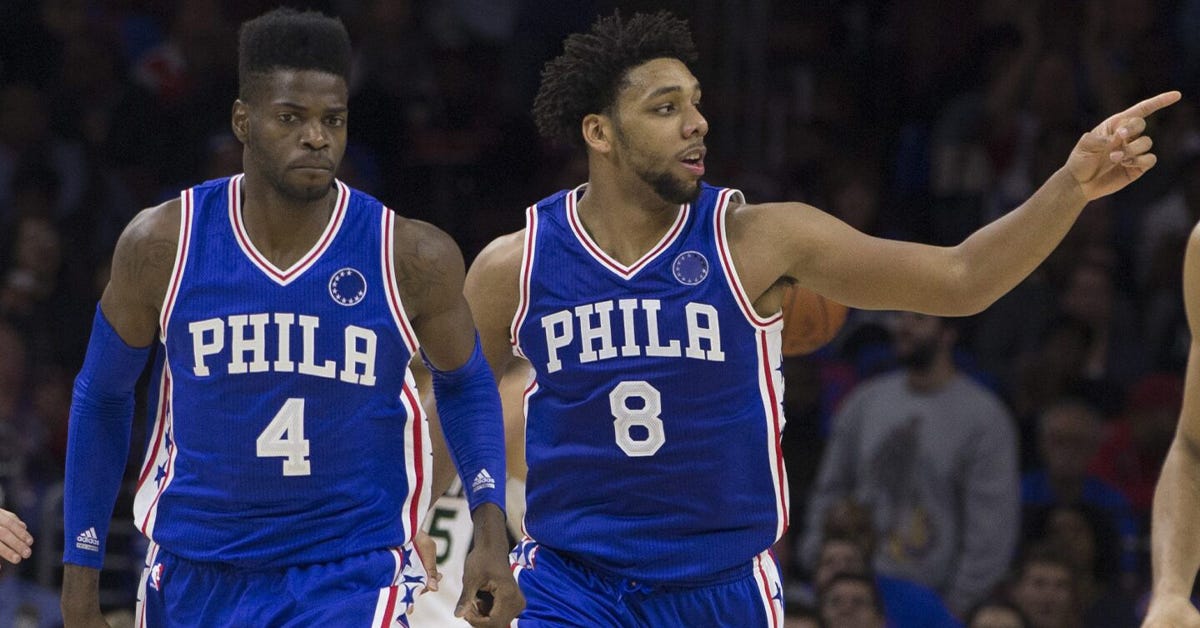
Yeah, I feel like timing’s everything. Because you’re right, the season before his rookie year, Golden State won its first championship with Steph. During his rookie year, that was when the Cavs came back and beat Golden State, and then Golden State won the next two. So it was very much like the game was getting away from a traditional center. If given the opportunity, how do you feel his career could have progressed?
ROB: The organization chose the best out of the three in Embiid. But that doesn’t mean that there wasn’t a role within the NBA for a guy like Okafor, right? Because he wasn’t a defensive anchor, but he was defensive enough. He was a big body in the lane. He was agile for the most part. And, you know, when it comes to offense, like he was elite. For me, it’s just a matter of allowing guys to show you what they can do. You give him a role, you get him around some veterans, you get him around some good leadership, and he’s going to be a good player.
So Okafor has this incredible rookie season, a lot of potential. I also forgot that he got into a street fight in Boston. Do you remember that?
ROB: Yeah, he punched a guy in the face or whatever in Boston.
Yeah. What happened after that? They were like 0-16, went to Boston. He got into a fight…
ROB: And that’s where the Sixers failed. It wasn’t even with just Okafor. It was Nerlens. Embiid. They were surrounded by all C-level players and rookies, with no veterans there. So there was no one there to help these guys manage the expectations of being professionals. There was no one there to help rally the troops or let a guy know, “This is not how the NBA works, bro. Like, you’re not going to win four games throughout the entire season normally. Keep your head young, fella. Keep working.” Like, there was nothing there.
And that was one of the problems with the Sixers, well into the Process. It was just a bunch of young guys trying to figure it out. You have this losing mentality throughout the organization, and you don’t have any veteran leadership there, or a will to want to win that rubs off. If you got any top player that comes in as probably a number one draft pick, these dudes probably only lost, like, seven games all throughout high school and college. And now they don’t win their first NBA game until December. Like, that’s crazy.
Do you see any parallels between him and what happened with Ben Simmons?
ROB: I mean, absolutely, bro. I really think the Sixers have done a little bit of a disservice to some of those star players, man. I mean, you look at even Embiid, you know. Being a professional is way different than just being good. And you hear all these old dudes talk about it now, like all the old dudes that have podcasts, that’s all they talk about. They’re like, “Yo, like being good in NBA is not just like going out and scoring 20 points.” And I think that’s where Okafor ran into issues because it’s like, if you’re averaging 17 points as a rookie and then the next year you’re not even playing. What does that say about you?
And what does that do to you mentally at the same time?
ROB: Because like, you know, the game is there, right? And if you have a veteran there, if you have a guy like, I don’t know, PJ Tucker or Kyle Lowry who’s on the bench now, it’s like, “Yo, young fella, you’re scoring 20 now, but the team is 6-47. So yeah, that’s great. But if you want to stay in this league, you need to learn how to play defense. You need to learn how to hit the mid-range or even expand the game up to a three.” And if you aren’t working on those things constantly, you’ll be out of the league.
Before the season even ends, is when Sam Hinke steps down. So like whatever plan dude had, it was out the window. Breakdown, what happens to the Sixers from there, and what happens to Jahlil Okafor?
ROB: From what I recall, Okafor was balling. But then, after that season, Embiid came back. And Embiid is nice. I remember hearing the buzz about Embiid. And I just remember everyone talking about, like, “Yo, he is busting ass in practice.” Like, he might be the greatest center ever.
This is before he’s ever played.
ROB: This is before he ever played. So at that point, you have Embiid, you have Nerlens, and you have Okafor all healthy going into Jahlil’s second season. It’s a little clunky. And I think they had a trade in place for Okafor, but the trade fell through.
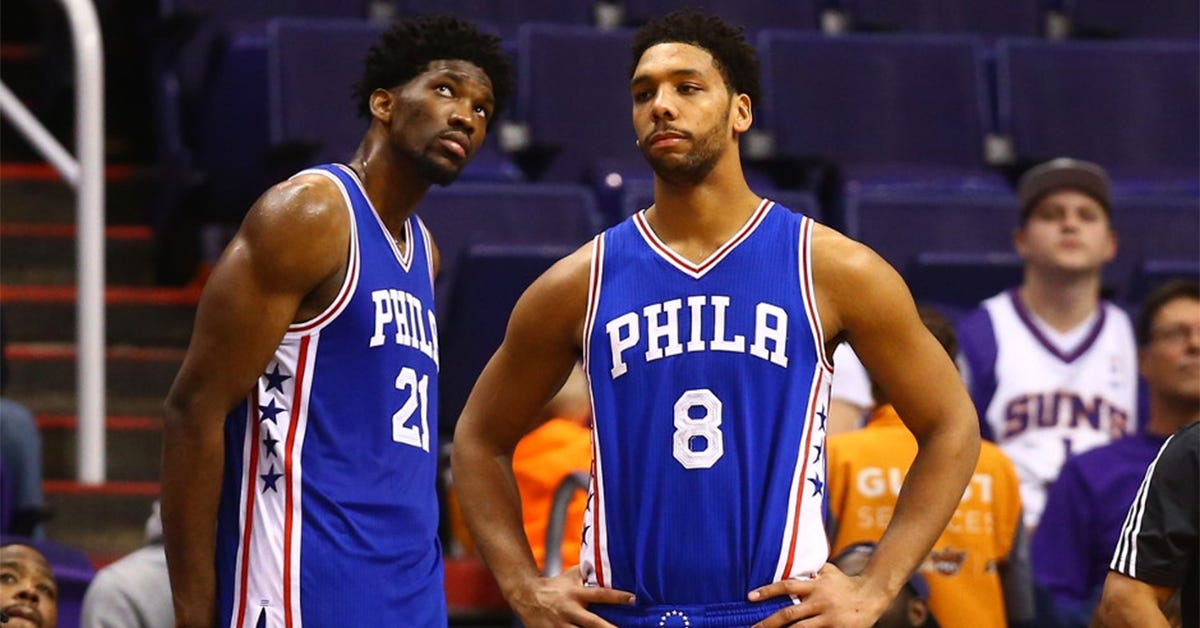
Do you remember the rumors that came out that Danny Ainge was trying to trade two first-round picks for Jahlil?
ROB: I remember that. There were some decent deals on the table for Okafor. And at that time, he was in and out of the rotation. When he was playing, he was getting buckets. And then he just wouldn’t play the next, like, four or five games, which was crazy. It was just like, “Yo, what is going on?” It was the strangest thing because they were trying to shop him. And I remember Nerlens got dealt first. And you would think, all right, when Nerlens is dealt Embiid and Okafor, will be balling.
And then, like, Okafor still wasn’t playing. He was still on the bench. They were playing, like, Richaun Holmes and a few other dudes. It was the craziest thing ever. And I think by that time his value diminished, which is the Sixers’ special. Having an asset that could probably net you way more than you probably should. And then by the time you actually sell the asset, you trade him for two pieces of paper and some chewed-up bubble gum.
So Okafor was traded to the Nets halfway through the 2017-2018 season. He was traded with Nik Stauskas and a second-round pick for Trevor Booker.
ROB: Bro, that’s trash.
In 2017, Okafor said, “This is my third year in the NBA, and I know it’s a business. I don’t know if it’s fair or not, but in talking to other people in the NBA, talking to retired players, one thing I’ve heard them say is that what’s going on with me isn’t right, and they’ve never seen anything like this before.” Do you agree?
ROB: I remember that people weren’t really that concerned about Jahlil Okafor because Embiid was emerging at that time. So it was a weird time for Okafor. I remember that because again, I’m an Okafor fan. So I’m just like, “What is going on with my guy, man?” They were just like doing him dirty. It wasn’t cool because he was a young player. He had great skill. He could be of value to someone, and he could probably also return value to us, but we were just holding on to him. It was crazy.
Do you feel like the Hinkie stepping down and Colangelo taking over had something to do with that?
ROB: Of course, because I think Hinke had a different plan. By the time Embiid was drafted, we kind of had some picks. You should start to see some of the fruits of all the tanking. And then when Colangelo kind of came in, it was bad.
I’m going to read you another quote, okay?
ROB: From Okafor?
No, this is from a Twitter account that’s called @EnoughUnknownSources. From that infamous report on Bryan Colangelo from The Ringer.
ROB: Oh, this is the burner account.
There’s allegedly a failed trade between the Pelicans and the Sixers. This account tweeted:
“Nobody wants him…he asked the front office not to let the info out. Still, the front office is not leaking the truth to save face. Okafor abusing that. If the truth came out, Okafor would be the one looking bad.”
That was from one of Bryan Angelo’s burner accounts that he ended up blaming on his wife. Even though officials from the Pelicans said that there was never an official deal in place. Do you feel like at least a decent GM could have gotten value for this dude, or could have found a way to implement him into the team?
ROB: Absolutely. When you have talented players, you find a way to make things work. This is how it works. You can never have too much talent on your team. A good GM, a good coach, a good organization finds ways to make your talent work, or at least make the talent work for you. You keep playing them until you trade them, or you find a role for him. They could have done a million different things to get some decent equity in return. With a competent general manager, with competent coaching, with competent player development, with competent veteran leadership, Jahlil could have had a better career.
I kind of feel like the Process gave a little bit of inspiration for the Thunder’s rebuild, too. What do you think Sam Presti got right that the Sixers didn’t in the Process era?
ROB: They made a lot of really, really good decisions. One of the differences between the Thunder is that they remained competitive throughout their rebuild. They never rebuilt to the point where they didn’t think being competitive wasn’t important.
Why do you feel like that’s important?
ROB: Because you have to keep your edge, man. You don’t want people to have a loser mentality. Being in the city of Philadelphia is crazy because when you see a loser, you’re just like, oh, man. When you have a loser mentality, it’s hard to believe that you can become something more. But when you’re winning, you always just think that you’re a winner.
Yeah. You feel like winning is almost like a skill?
ROB: Winning is a mindset, bro. You look at even when Shai played with the Clippers. He played with the Thunder. It was still competitive. When they brought in Chris Paul, he was teaching Shai how to be scrappy and win. They were in the playoffs.
So, you know, it’s important. I think that was the biggest takeaway from those Process days. There was way too much losing. Brett Brown had a losing mentality. I’m not saying that he’s a loser, but he wasn’t winning any games bro.
That’s the quote of the interview. “I’m not saying Brett Brown’s a loser, but…”
ROB: Look at his head coaching record. He was getting paid for them to lose games and to be okay with losing games. It’s not that he was a bad coach or anything, but he wasn’t really given much to work with until much later on. And then by that point, he’s like…”I’ve been playing losing basketball for so long. Now you want me to play meaningful basketball?” It’s crazy.
I feel like Embiid didn’t really like hit the next level until he was surrounded with veterans, like J.J. and Jimmy Butler
ROB: Jimmy Butler was like the turning point for him because he was there, and he was like, “Whatever y’all were doing before that shit was losing mentality,” and you know it was bad because they literally kicked him out for it. He literally had to leave Philadelphia because he had seen what winning looks like, what good ownership looks like, and what NBA basketball looks like. And was like, “Whatever’s going on here is not what it was like in Minnesota. It wasn’t like this in Chicago. Like, Thibs didn’t do this. No other coaches do this. This is some bullshit.”
Alright, I have two more questions for you. First one, do you think, do you think the Process was successful? And do you think the Sixers learned from what happened to Jahlil Okafor?
ROB: No. Both answers.
No, to both.
ROB: The Process is not going to be successful unless they at least make it to a Conference Championship. Like, you tanked, you literally sacrificed years. You make it to the playoffs and have one really historic run, and that was when they lost to the Raptors in the conference semis. Every other playoff run has been underwhelming. I just don’t know if it was worth it. You collected multiple draft picks, and you literally derailed mad players’ careers.
This is giving me PTSD.
ROB: It was crazy, bro.
He’s not the only one they ruined
- Ben Simmons
- Markelle Fultz