


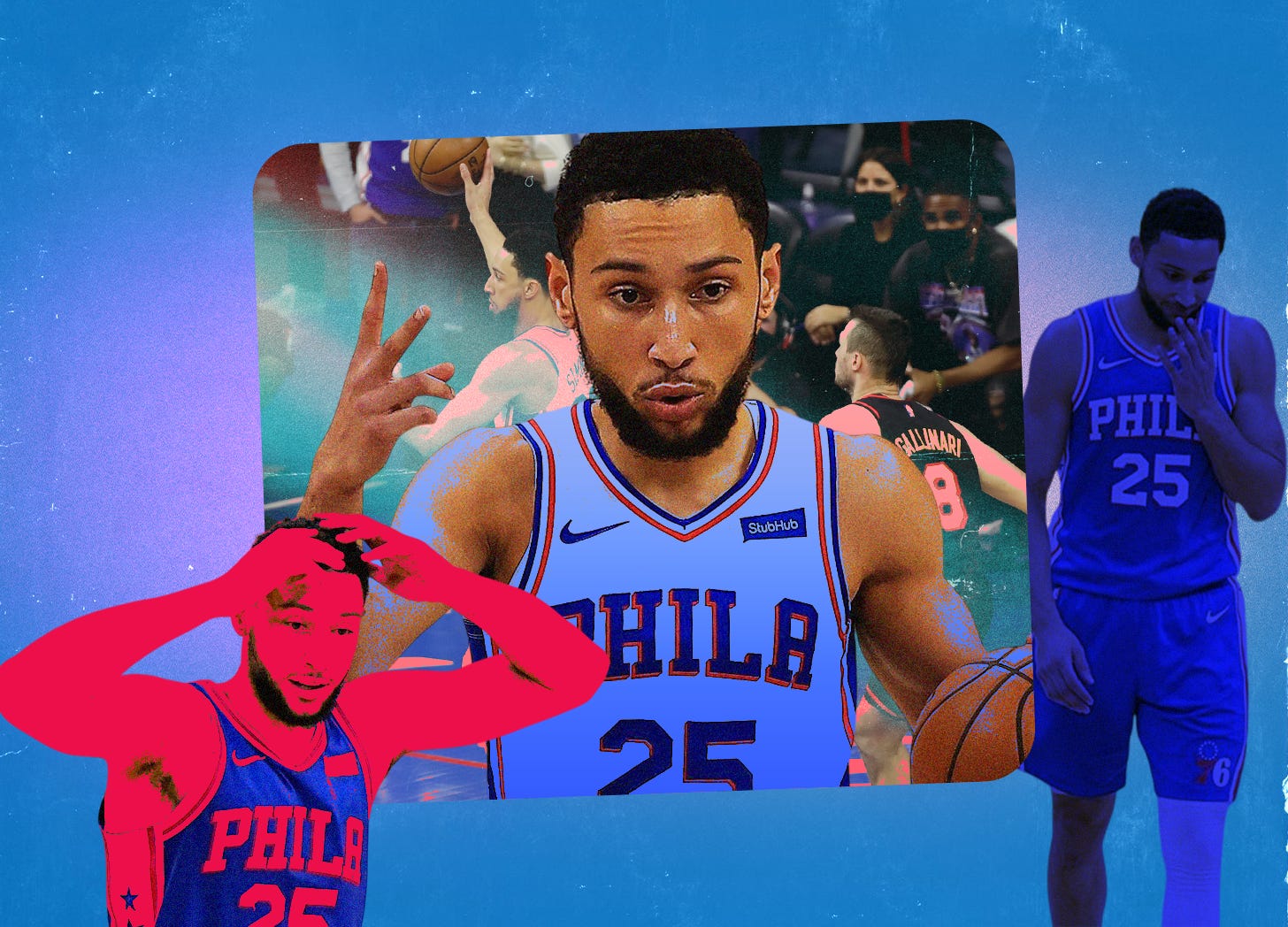
Sometimes I have these recurring nightmares. In one, I’m putting on my cap and gown for my college graduation, only to realize I never passed my organic chemistry class and I won’t be graduating that day. In another one, the Sixers are playing the Atlanta Hawks in the 2021 playoffs, and Ben Simmons passes up a wide-open layup under the basket.
The moment seems like eons ago, thanks in part to the blessing that is the 2026 Philadelphia 76ers and all of their (non-Celtics game) good vibes. But it’s recently floated back into consciousness thanks to what feels like thousands of clips from the “Being Ben” documentary, a project that feels like a college kid writing their memoir.
Simmons has always been a tantalizing prospect, whose elite vision and athleticism made you fall in love with his potential. I remember watching Montverde Academy highlights just to see Simmons carve up high school kids. His time with the Sixers was complicated, but that potential always felt bright. And after a lengthy break from the league, Ben was on his way back this season with the Sacramento Kings for another shot to capture that luster, until he suffered a torn Achilles tendon.
So today, I’m sharing a convo with my buddy and one of my favorite Substack writers Neil Paine. Neil runs Neil’s Substack, and is a sports writer who uses a beautiful combination of statistics and narratives to highlight different angles of your favorite sports stories. Today Neil and I talk about Ben Simmons, and that time Neil gave Ben a phenomenal player comp on live television.
NEIL: On an ESPN-owned studio with the great Kate Fagan, one of my favorite people that I worked with. Ben Simmons was in college at the time. Am I allowed to speak his name? Is it like a Voldemort? Is this a Voldemort situation?
We might get struck by lightning in a matter of seconds.
NEIL: But anyway, I said he would be a combination of Tim Duncan and Lamar Odom in the NBA.
What was it about Ben Simmons that gave you that take?
NEIL: I looked at the stats. If you go back, you could probably link the clip that I sent you of a much younger me. And I had a video board because that was like the thing to have back then. And I had these charts where I had looked at forwards who were going to be drafted top five or something in the NBA going back to the ‘80s or something.

And I was like benchmarking their stats against each other and seeing where he ranked relative to these guys in points, usage rate, rebounds, assists, steals, etc. Even “steals plus blocks,” or STOCKS as they call them, which I still don’t know how I feel about that term. But anyway, I did the comparison, and those were the two ones that came up as most similar.
Ben Simmons was a very weird player, right. I think those two kind of tell you about the potential that he had and what he could have been. Lamar Odom was a really good point-forward type of guy, and he could shoot a little too, but he could defend.
And then Tim Duncan obviously was like the GOAT power forward. It’s a little silly to think, to even invoke his name in this. But rebounding, defense, like interior defense, and just being able to make shots inside. So it was like, if Ben Simmons has aspects of both of these dudes, you could have a dude that was a chess piece that could be used all over.
And in fairness, that’s basically kind of what he was in his first few years in the NBA. The one thing that I discounted is that if you can’t shoot, none of that other stuff matters. It’s really like if you are so bad that you literally do not make a three-pointer for your first...I think it took him, what, three years in the NBA to make his first three-pointer?
I remember the standing ovation at the Sixers game.
NEIL: I do too. And I was like, it’s kind of sarcastic and kind of not. So for me, it was a real learning experience in that way because it teaches you that a player is not the sum of their parts. That it’s really kind of a weak link. If your weakness is that bad and you can’t shoot at all, then it really destroys the power of all the other stuff.
Before he got hurt, he was legitimately 90th percentile in all those other things. He was a Defensive Player of the Year candidate who had like a 40% assist rate and was capable of running an offense. He had size, and he could do a lot of things. He just couldn’t shoot.
Do you feel like that happens a lot in the evaluation of players in terms of not understanding the impact on the team dynamic that they’re about to enter? Do we ignore context?
NEIL: We might be getting better at it because of things like that. But I do also think that I think coaches and maybe scouts, by extension, have this attitude of like “we can fix him.”
Totally.
NEIL: I mean, can you think of another player that was drafted as high as him that came in not being able to shoot but could play the perimeter and had all of those skills that they didn’t at least coach up to some baseline level of shooting?
I really honestly think maybe we can look it up, because I have the tab of his stats from Basketball Reference open. Okay, I’ll put you on the spot. How many career three-pointers would you guess that Ben Simmons made?
Honestly, I would say like four?
NEIL: You’re actually very close. Five. He’s made five three-pointers. He’s 5/36 in his career, which is a 13.9% success rate.
How does that happen playing in the modern NBA, yeah, on a team like the 76ers?
NEIL: It’s a great question. And I think also, to your point about the team he was going to. That team was at the vanguard of analytics. And like if anybody should, a) know how to teach somebody to shoot, and b) not take somebody who can’t shoot, it should be them. He had years where he actually stopped taking them just because maybe he was too hesitant to do it.
What’s really incredible about Ben Simmons too is, like, I like to say that what I love about Jalen Hurts is that his superpower is that he constantly gets better every year. And I think that’s a skill.
NEIL: Totally.
Ben Simmons is very skilled at convincing you he’s getting better every year. Because he has phenomenal workout videos.
NEIL: Dude, his workouts are unbelievable.
Unbelievable.
NEIL: He’s the best workout player in the league. Best workout player. My wife said, you know, that I should put together a tape of myself playing and say that I’ve recovered my athleticism and then only keep the clips where I make the shots.
Neil Paine has gotten his athleticism back.
NEIL: I’ve got my athleticism back. Says he’s ready to come play.
When you watched him in college, do you feel like it backed up a lot of the stats that you saw?
NEIL: Yeah, I mean, he was a legitimately dominant statistical player for sure, and you could kind of see that in terms of how he could do a lot of the stuff that he ended up doing. He could back down smaller guards in the post. He’s great in transition. It’s rare that a number one overall pick misses the NCAA Tournament because usually they’re able to at least overcome it.
So, you know, that was a little weird. But I think in college, he showed a lot of the flashes, and I think he’s like the only player whose shooting was more encouraging in college than it was in the NBA. I don’t want to pretend and sugarcoat and say that his numbers in college were good or whatever. But you could understand.
Again, to invoke a ridiculous comparison. LeBron James came into the NBA and was, like, not a very good shooter. And it took him years to become a good shooter. And he was so good at the other stuff that he became the best player in the NBA while being a bottom 25% shooter or something. Because it didn’t matter, you know. And he was good enough. Simmons was not that generational.
Some people in Philly got a little reckless (myself included).
NEIL: We did get a little fired up for him for sure. But look, dude, I was ready to send Michael Carter-Williams to the Hall of Fame after two games.
That was the great bait-and-switch of that era. They would get guys who had athleticism and every handful of games they would have these amazing highlights.
Like a Nerlens Noel.
NEIL: Oh, absolutely. And they would get those guys. They would put them in the absolute best position to look good. And then they would sell high and ship them off. And they did that a lot of times.
When you watched Ben Simmons in college, what were the red flags? If you’re being honest with a young Neil.
NEIL: The shooting and the lack of team success. You would really want him to impose his will on some of those games. If I’m remembering right, down the stretch of the SEC regular season, they were losing some close games where you’d really want him to put his imprint on those games. And he wouldn’t do it. And that’s eventually what he retreated into becoming because he was a guy who, early in his career, was an assertive part of the offense.
And then by the end, after he got completely psychologically destroyed by, you know, everyone, he was very hesitant to step forward and take a role in the offense.
I also think a lot about the expectations in any sport that are put on a player who has a certain level of acclaim. I wonder if Ben Simmons was drafted later, would he have a more successful career?
NEIL: Yeah. I think the injuries are definitely part of it as well. Provided that he’s healthy, I do think you’re right that basically number one pick was a bad place for him to be picked. And coming to Philly was, like, the worst place that he could have gone to. So if he had gone, like, you know, fifth overall to Charlotte, I don’t know, like, what’s a place that, you know, maybe you could go to?
Sacramento.
NEIL: Really, as long as you avoid places where the press is going to destroy you. I think also if he had gotten better coaching. I don’t want to rip the coaching staff, but it does seem like it was a recurring thing for the Sixers to take players really high, and then those players immediately had problems. It’s just this laundry list.
Markelle Fultz. Zhaire Smith.
NEIL: I don’t want to say don’t ask things of players because some players want that. Like you said, that’s why I think Jaylen Brown is so perfect for Philly because he’s a player that every time you ask him to do more, he says, “I am going to prove I can do this.” He’s got that dog in him that he wants that mantle. Some guys are built that way. I think Ben Simmons is not built that way.
As a coach, Phil Jackson was great at coaching different players differently based on how they would respond to things. He would treat Michael Jordan a particular way that he would not treat Scottie Pippen because he knew Jordan could handle being pushed, and that would actually activate something in Jordan, like a, “Fuck you, I’m going to prove you wrong.” You do that to Pippen, he shuts down, and he refuses to kind of do it for you. And Ben Simmons was much more of a Pippen.
What do you think was the peak of Ben Simmons’ career?
NEIL: It was like right up until he passed up that open dunk.
Do you remember watching that live? I didn’t understand.
NEIL: My mouth was open.
I was like, am I wrong? Is he making the right play? And he passed it to Matisse Thybulle.
NEIL: It was a crazy play, but I think up to that point was really every successive playoff, we had sort of conversations about, “Is Simmons going to take the leap?” Basically waiting for him to announce himself. And he kept collecting accolades. So I think you could draw a bright line in his career between before that play and after that play. Because that was when we collectively just sort of said he’s never going to become what we want him to be, is he? He could exist in our mind up until that point. And it is crazy to think, like, one play could change someone’s legacy that much.
100%. In that moment. I also think, like, maybe Doc Rivers is the wrong coach to meet that moment. And many moments, to be honest.
NEIL: If you’re counting on Doc Rivers in a playoff situation, that’s probably your first mistake. I think there’s a long lineage of Philly athletes that sort of do fall into the Ben Simmons archetype. Like, I remember Ricky Watters. There was a play where he refused to lay out for a ball that was thrown over the middle. And then he said after, they were like, why didn’t you try to catch that ball? And he was like, oh, why should I put myself out there and try to get hurt? For who? For what? And that was the end of his Philly. And he’s a great player, too.
He was a great player, but you can’t do that in Philly.
NEIL: There have been many players for whom there’s just some dividing line. And I think it always revolves around roughness, either of a mental or a physical, or both. Like Eric Lindros, after he got all those injuries, you know, the concussions and everything, which really weren’t even his fault, but just like the vibe around him suddenly soured.
Even a Donovan McNabb. A guy who was physically very tough. He gave a lot to the city. But he was a very sensitive guy. Would not take a lot of accountability. And the city kind of like destroyed him.
NEIL: The T.O. situation was his moment. Where until T.O. became a Cowboy, I think we sided with T.O. over Donovan, and that kind of fucked things up with both guys forever.
What would you say to a young Neil about Ben Simmons? A boy who had so much hope. So many dreams.
NEIL: I would still do the segment again because it was fun. The segment content was kind of embarrassing, but the charts, those were fire. Go back and check those out. I got to make more of those.
The charts, they were fire 🔥